The Tension Is Unbreakable, Or A Trip Back In Time To When M. Night Shymalan Was A Great Storyteller
Part Four of a five-part series entitled, How To Write A Story, A Good Story, And Finally A Great Story. You can read Parts One, Two, and Three here.
I really want to finish my series on how to write a good story, but there’s this man in my apartment, harassing me. He’s not saying a thing, just sitting in the corner with a vicious looking cat o’ nine tails. Every time I begin to type, he clears his throat. I’m going to keep working, but if I don’t make it through to the end, please notify the authorities.
In any case, what was I writing about? Oh yeah, tension. Even more so than suspense, tension is the glue that connects your story with your audience.
ten·sion [ten-shuhn] noun
Mental or emotional strain; intense, suppressed suspense, anxiety, or excitement.
A basic tenet of narrative fiction is that you must have conflict. Without it, your story dies a limp, anti-climactic death on the page. It’s one of the first things we learn about in creative writing classes.
I’m not going to say that’s wrong, but I do believe it could be taught better, because conflict isn’t really what we mean. Conflict by itself does not generate interest. It might, in fact, be off-putting if all you’ve got is people fighting in your story, with no rhyme or reason behind it.
Tension is both a particular form of conflict, and as the definition above points out, a brand of suspense as well. Tension is about potential energy.
You place a loaded gun on the desk in front of you. This cannot help but create tension. Pick up the gun and the tension increases. It might go off at any time. As long as the gun is there, we won’t be able to completely forget about it. That’s tension.
Tension is related to suspense, in that the audience wants to know how the tension will be resolved. Is the gun going to be fired? Who will do the shooting? Who will be shot? Well-manufactured tension grips the audience and creates that edge of the seat experience in movies, and the I-can’t-put-this-book-down-until-this-shit-gets-resolved feeling in books.
If you can do a good job of creating tension in your stories, then you will succeed as a writer. This I guarantee.
Let’s look at some examples. We’ll start with two scenes from the M. Night Shymalan movie Unbreakable (unfortunately the only available clips are incomplete and of poor quality):
In scene one, Bruce Willis is weightlifting with his son in the garage. The question is posed how much he can lift. A simple challenge, one that might create mild suspense. But they quickly discover that he can keep adding weights, until it becomes an incredible, almost frightening amount.
I love this scene because it takes what is an ordinary activity and steeps it in heavy amounts of import. The movie is moving along as we try to discover what is different about Bruce Willis’s character. How did he survive that train crash? That question hangs over the scene, helping to ramp up the tension. And as the amount of weight continues to increase, a sense of danger begins to seep in. Both because Bruce Willis might be hurt, but also because, maybe he can’t be hurt.
It’s a splendidly crafted scene. This is the kind of tension we want to aim for as writers. Let me highlight the important takeaways:
1. The tension grows naturally out of the events before it. A scene by itself can be intense, but it becomes even more intense if it’s weighed down (pun intended) by all that came before. Ex: A thief robbing a bank is a tense scene, but if that thief is being compelled to act in order to raise money for a sick spouse, then it becomes even more critical.
2. There is a POTENTIAL for great danger/excitement. Tension is always about waiting for something in the scene to break out. As I mentioned before, we have the danger of the weights harming Bruce Willis, but the added excitement of Bruce Willis being the possessor of some kind of super power. The thought is dangerous to him and his son, but for the audience it’s attractive. From either perspective, there is tension. It’s increased further by having the son stand just outside the room, implying he would be in danger of being hurt by the weights should Bruce Willis drop them.
3. It builds gradually. The key to tension, much like a loaf of homemade bread, is that you have to let it rise over time. If the son had added all the weights the first time, the scene would have been much less effective (and this is probably one of the problems with modern entertainment. In order to get to the big action scenes, there’s not the time and space for slowly building the tension anymore).
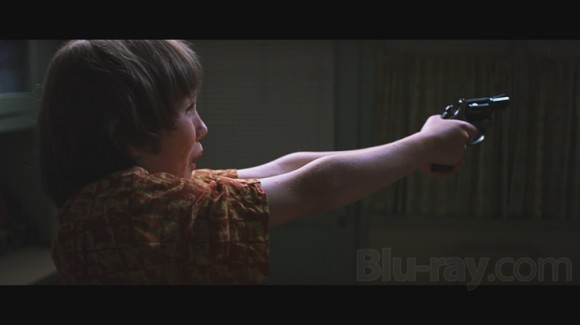
The second scene I want to look at occurs a bit later in the movie, as the tension has continued to build. The son comes into the kitchen and threatens to shoot his father with a gun in order to prove that he’s a super hero. Oh my God, what a fantastic scene!
Guns and gun violence have become so prevalent in our popular culture that it’s rare to have a scene that can create such tension with just a single gun, one that doesn’t even get fired. Here are the reasons why the scene was so effective, with each element adding to the tension:
(Note, this scene has been altered, but there’s enough there to get an idea of the high stakes involved)
1. We still don’t know what will happen if Bruce Willis gets shot. Will he survive? The audience is conflicted, both desiring to see him get shot and proven invulnerable, while at the same time fearing that if he does get shot he’ll be wounded or killed.
2. The person wielding the gun is a child. He believes he’s doing a good thing, but is obviously misguided. Even if Bruce Willis survives the gunshot unharmed, it still will have a been an awful thing for the boy to do, because their is the potential it will kill his father. Adding to the poignancy, the boy desperately wants to prove that Bruce Willis is a superhero.
3. Most fundamentally, as with anytime a character points a gun at someone in a work of fiction, we are wondering if the boy will pull the trigger. The louder Bruce Willis shouts at his son to put the gun down, the more we anticipate the sound of the gun firing.
4. By threatening to leave for New York if his son pulls the trigger, Bruce Willis is raising the stakes even further. Even if he does survive, he’s promising dire consequences for the boy’s actions.
I hope these two scene reviews give you an idea of how to properly employ tension in a scene.
When used in tandem, tension and suspense are the most effective tools in your toolbox. Whenever I write something (longer than 100 words) I get an idea of the overall story, and then I try to identify the key scenes. I shape the story around these scenes in order to maximize the tension. It’s important to avoid thinking linearly, because as I said before, this happens, then this happens, then this happens, does not make for an interesting narrative.
Remember, tension and suspense aren’t about action. That’s why so many of today’s movies are disposable. There’s a lot of spectacle, but nothing truly worthwhile that will keep you thinking about them even a few days later.
I know that I’ve relied on movies to illustrate my points, because it makes for a more interesting post to be able to include video, but the same principles work equally well for literature. Think of your favorite books. What scenes stand out most? I bet they are heavily infused with tension and suspense. In the coming weeks, I’ll be writing more posts that more closely examine tension in specific works.
For now, I’ll leave you with one last scene from Unbreakable, which is all dialogue, to show you how tension can be created just with words.
If the conversations in your story are just moving along the plot, then you aren’t doing your job as a storyteller. You need to use your conversations to increase the tension and suspense, like the scene above.
Okay, I better go now. The man in the corner is pointing to his mouth and rubbing his stomach. I think it’s his feeding time. See you tomorrow, when I’ll wrap things up by explaining how to turn your good story into a great story.
 Check out Decater's novel, available now at Amazon. Plus, don't forget his other books: They Both Love Vonnegut, Ahab's Adventures in Wonderland, and Picasso Painted Dinosaurs.
Related Posts


About The Author

the good doctor
Life is a constant battle versus my own entropy.