The Mellifluous Narrations of Michael Caine And Sam Elliot
Part Three of a five-part series entitled, How To Write A Story, A Good Story, And Finally A Great Story. You can read Parts One and Two here.
I was about to sit down and compose the next installment of my piece on how to write good stories, but I was interrupted by a knock at the door. This naturally piqued my curiosity, as it’s not often that I get visitors. Because the last time I answered my door, it was the police and I spent the next 6 hours being questioned at the Public Security Bureau, I hesitated to answer. But the knocking became quite insistent and it seemed unlikely my mysterious visitor would leave any time soon. I reluctanly went to the door.
But before I reveal who was waiting on the other side, it’s time for us to talk about suspense.
sus·pense (s-spns) n.
Pleasurable excitement and anticipation regarding an outcome, such as the ending of a mystery novel.
Of the two crucial elements I mentioned yesterday, suspense is the easier to explain, the easier to understand, and the easier to implement. We’ll save the slightly more challenging tension for tomorrow.
Simply put, suspense is a tool used by authors to make the audience want to know what happens next. It is most classically associated with the idea of cliffhangers. We all know what cliffhangers are, so I won’t bother to define them, except to point out that the obvious or repetitive use of cliffhangers can actually spoil what would otherwise be a good story. What we’re looking for is far more subtle, yet much more effective at the same time.
Suspense is about getting the audience to ask questions. We, as storytellers, raise doubts or create a mystery, hoping that the audience will want to know the answers. The phone rings, so naturally we want to know who’s on the other end. The doctor says she has good news and bad news. Someone slips a note into the main character’s pocket, asking him to meet outside the library at midnight. Read any book, watch any movie, and any number of questions will be raised in the early going (and likely all the way to the conclusion). In some ways, every story is a mystery and the reader is the detective.
A masterful story teller knows how to raise interesting questions while doling out the answers slowly yet compellingly. If one question gets answered, you can bet it leads immediately to another, more important question. A cop chases down a suspect only to find that he’s been murdered. A woman reads the letter that’s been waiting on her desk all day, and finds an anonymous invitation to that night’s ball. Questions follow answers.
Stop right there. We already know about suspense. You’re not breaking new ground.
All right. I hear you. But here’s where I’m going to earn all that money you’re paying me.
I wrote earlier that suspense and tension are the two most important factors in creating a good story. Not characters. Not plot. Not style. Suspense and tension. That means when you’re creating your story, everything you do should be with those two elements in mind. If you’re writing a novel, you have to look at every chapter and ask yourself why is the reader going to read the next chapter (Think back to my Dan Brown example. Isn’t it obvious he constantly asks himself that question. Every chapter ends with a new question the reader wants answered. That’s why his books, as cliched and formulaic as they are, are such great page turners.)
If you’re writing a short story, every paragraph should provide motivation. In microfiction, every sentence. You have to constantly ask yourself how am I hooking the audience.
If you’re like me, then you spend an inordinate amount of time with your first sentences. You want them to be interesting and compelling and original. You imagine a reader picking up your book in a bookstore and reading that first sentence and you want them to fall in love with your novel in that first moment.
That’s the exact care you must take with every part of your story. With so much competing entertainment, any moment might be the one your reader puts down your book and forgets to pick it up again. Every page has to be unforgettable, and the best way to bore deep into your readers’ souls is to get them wondering what’s going to happen.
If your story is simply a series of events, where this happens, and then this, and then this, and finally this conclusion, then it won’t be that interesting. No matter what genre you’re writing in, think of your narrative as a mystery. Each episode will offer clues. Then, piece by piece, the reader will gain a fuller picture. Your story might unfold in chronological order, but the way you tell it can still be suspenseful by raising questions in the right places and withholding information in the right amount.
Let me offer a couple of examples of how different storytellers use suspense at the start of their narratives, and then I want you to start applying these ideas to your own work.
Watch the opening scene from The Prestige:
The movie opens with a splendor of top hats (the collective noun for top hats) strewn across the forest floor. This is certainly unusual, and considering we’re sitting down to watch a movie about dueling magicians, thematically appropriate. Since it’s such an unexpected opening, the hats will certainly make the audience wonder about their meaning, but at the same time, without any other context, it’s unable to create much suspense. It isn’t until much later that we’ll realize their import, and by then we’ll have forgotten all about the opening.
The true opening is a pair of interconnected scenes narrated by Michael Caine and his wonderful cockney accent. Each scene depicts a magic trick–both appropriate and guaranteed to create immediate suspense in the audience. As Caine explains the structure of a magic trick, the watcher is busy trying to make sense of the tricks for him or herself. We naturally want to know how a magic trick works.
At the same time, we quickly understand that the scene with Wolverine and Batman is from the climax (or a climax) of the movie. This is a common technique, where we’re given a sneak preview of where the movie is going to end up. The scene fades out with Wolverine about to drown while Batman watches (both very uncharacteristic behaviors). We’re left to wonder both how he got into that situation and how he’s going to get out. The cut to the trial then suggests that Wolverine was unable to escape.
The flash forward is one of many possible techniques for creating suspense.
Here’s a second example, from The Big Lebowski:
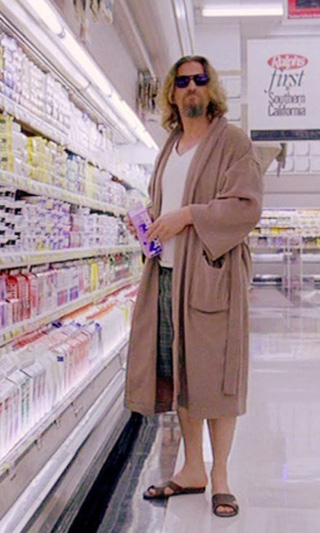
It starts with another narrator, this time Sam Elliot, who introduces us to the Dude. The nickname in itself is intriguing, but he goes on to tell us some gems such as, “There’s a whole lot about the Dude that didn’t make sense to me,” and “Then again, maybe that’s why I found the place so darn interesting.” He’s telling us this story is both confusing and worth paying attention to.
The Coen Brothers are creating suspense through character. Who is this guy? Why is he going to the grocery store in his slippers? Why does he call himself the Dude? I want to know about this character.
But to me, the real golden nugget in the opening sequence, in terms of suspense, is when the Dude opens the milk carton in the grocery store and smells it. I immediately want to know if he is going to drink it, if he is going to put it back on the shelf, or if he is going to pay for it? Of course, the answer comes a moment later, when we see him writing a check for 67 cents with milk on his mustache. But by opening with this bizarre, yet prosaic, moment from the Dude, we’re immediately intrigued by who this guy is, and we’re certain to remember it.
For a final kicker, the clip ends with the Dude walking into his house and not realizing someone is waiting behind him. In the context of the clip, that is a cliffhanger, though of course within the scene itself, it’s creating tension, which we’ll get to later.
The point is, in both scenes, questions are raised, and reasons are given for us to keep watching.
The number one idea I want you to take away from this discussion of suspense has nothing to do with the accents of Michael Caine and Sam Elliot. It’s that in everything you write, you should be asking yourself why the reader is going to keep reading. You, as the storyteller, are raising questions for your audience, every step along the way.
Yes, characters are important. Sure, plot is important as well. The world you create is important as is the tone you set. But it all comes back to tension and suspense. You create compelling characters by not giving all the information about them right away. There are things in their past that they’d rather forget and they aren’t telling us about. New characters show up and we wonder who they are and what they want. Good characters are suspenseful characters.
When you’re writing a fantasy novel, it’s probably very tempting to reveal all the fantastic aspects of the world you’ve concocted right away, but a good storyteller will give out that information slowly, with teases and hints of things that won’t make sense until later. You give just enough glimpses of the world to make the reader want to know more. Tolkien very rarely explains his world. He just presents his story within that world, and we learn the bits we need to know as the story progresses.
So that’s an introduction to suspense. I’ll be writing future posts that look at different scenes from literature and movies that exemplify its use. In the meantime, I’d love to hear about your favorite moments of suspense from movies, TV, and books in the comments below. You can also have a look at today’s 100 word story, which specifically illustrates suspense. Feel free to submit your own example. And I’ll be back tomorrow with my discussion of tension.
Congratulations. Now that you’ve made it all the way to the end, I would love to reveal who was knocking at my door. Sadly, I have no answer for you. You see, when I opened the door, which just moments before someone had been banging on quite rudely, no one was there. Dun na na naaaa!
 Check out Decater's novel, available now at Amazon. Plus, don't forget his other books: They Both Love Vonnegut, Ahab's Adventures in Wonderland, and Picasso Painted Dinosaurs.
Related Posts


About The Author

the good doctor
Life is a constant battle versus my own entropy.